Deployable radiator wings
The feather panels are the cooling system. They open to shed heat from the drives and power plant, and fold down when she needs to be narrow or quiet. Pretty is a side effect.
Thermal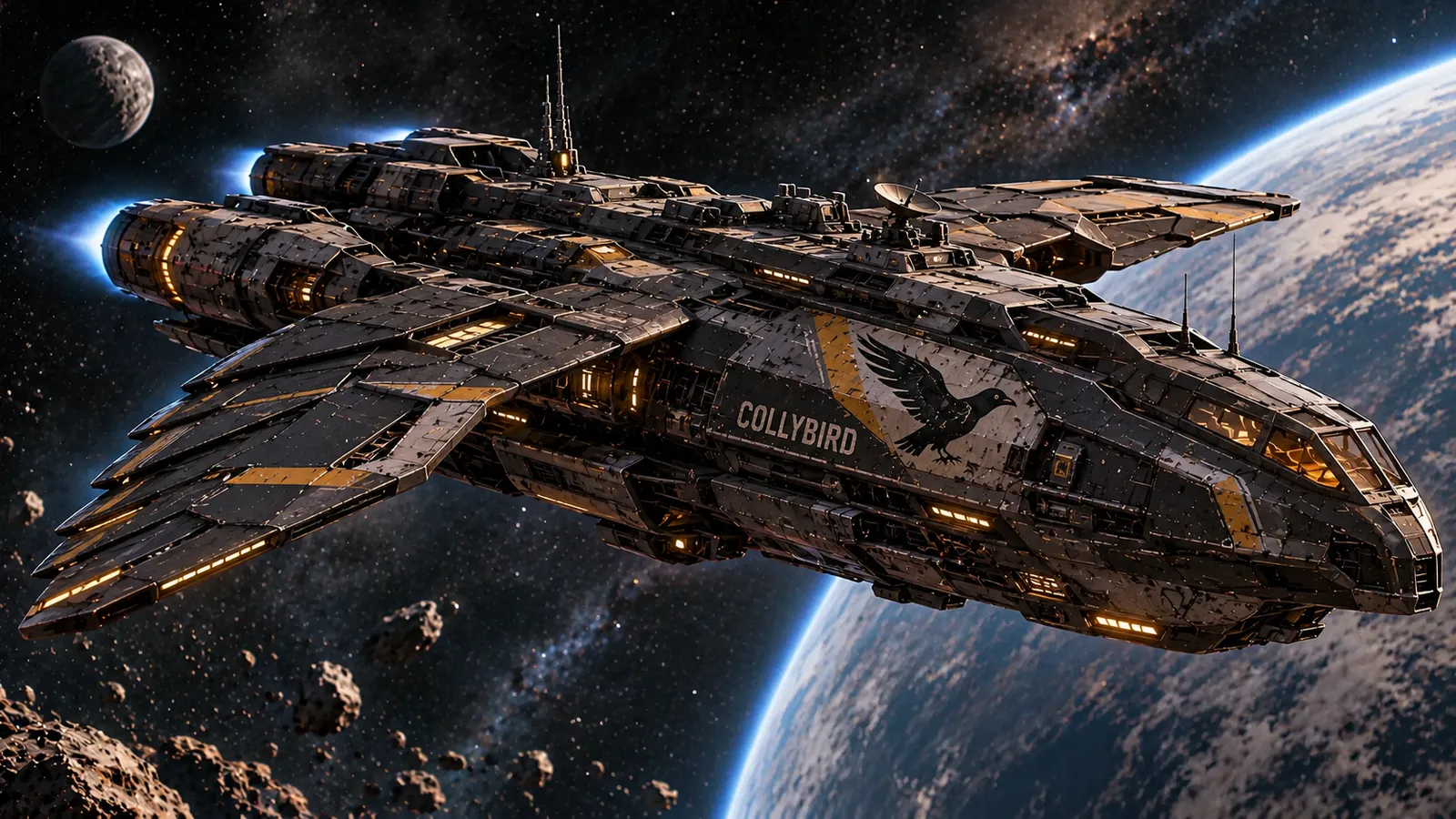
Built for the long way around.
Some ships are built to impress. Some are built to survive. The Collybird was built to do both, although she'd probably deny the first.
Beautiful in flight. Stubborn on the ground.
A ship with character
The Collybird has been patched, re-plated, re-wired and argued over for longer than most of her crew have been alive. Nobody remembers which panel is original anymore. The ones that matter are the ones still holding.
She came off a yard that no longer exists, and almost nothing has left her unchanged since. A cargo run through a debris field cost her a nacelle cowling; the replacement came off a hauler that didn't need it anymore. A hard set-down on a world with no name and worse weather bent a landing strut, and the strut that went back on is heavier, uglier and has never given anyone a reason to complain.
She is not the newest ship in the lane. She is not the fastest, and she has never once been the prettiest at the pad. What she is, reliably, is still flying — and when something goes wrong out past the shipping lanes, that is the only specification anybody actually cares about.
Salvaged. Doesn't match. Doesn't leak.
Replaced twice. The second set is thicker than the yard ever intended.
Original. Scarred, scorched, bolted down, and non-negotiable.
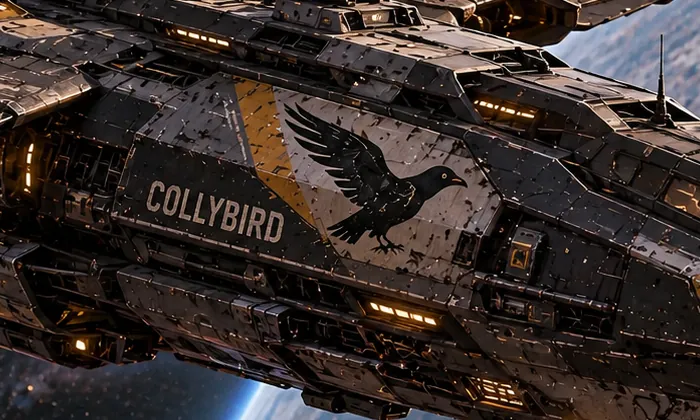
Every scar has a story. Every system has a purpose.
Designed like a blackbird
Collybird is an old word for a blackbird — the one that survived into the carol about four of them baked in a pie. It suits her. Black, common, clever, and almost impossible to get rid of.
The resemblance isn't styling. Nobody set out to build a bird. They set out to dissipate an enormous amount of waste heat, armour a hull against micrometeorites on a working budget, and keep every service panel reachable with a crew of a few. What came back off the drafting table was a broad, swept, overlapping shape that looks like a blackbird because a blackbird solved the same problems first.
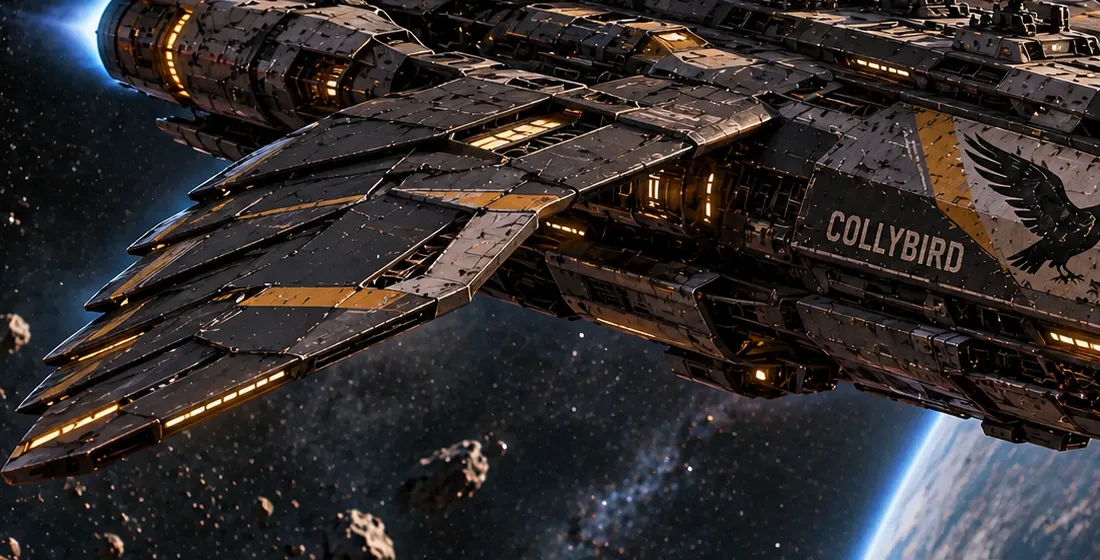
Hover, tap or tab through the list to locate each assembly on the airframe.

The hull is matte black and charcoal, and it stays that way until the light hits it at an angle — then the plating throws a faint blue-purple sheen, the way a real blackbird does. It is not paint. It is what happens when overlapping armour catches a star.
The warm light is deliberate. Cockpit glass, hatch surrounds, ramp lighting and the navigation markers all run the same amber, so that from a long way out you can tell which way she's facing and whether anyone's home. Crews who've worked a dark pad will tell you that reads as friendly. It is meant to.
The mark on her flank is the same bird, one wing short a feather. It has been repainted four times and nobody has ever repaired the wing.
Engineering that earns its keep
There is no trim on this ship. If a thing is bolted to the Collybird, it is because somebody could name what it does and what happens when it stops.
The feather panels are the cooling system. They open to shed heat from the drives and power plant, and fold down when she needs to be narrow or quiet. Pretty is a side effect.
ThermalAttitude control lives inboard, inside the armour, where grit and debris can't reach it. She handles like a smaller ship right up until you ask her to stop.
ControlOverlapping plate, heaviest along the leading edges and the upper hull. Sectional by design: damage one, swap one. Half her panels have been swapped at least once.
StructureNot everything in the engine room came from the same factory, or the same decade. It all came from something that was flying, and an engineer who knew why it stopped.
PropulsionRacks, clamps and tie-downs on a standard grid, so the bay reconfigures for crates, livestock, machinery or passengers between one port and the next.
CargoHeavy hydraulic struts with long travel and wide feet. They let her sit level on a slope, on gravel, on mud, and on at least one occasion on a frozen lake.
GroundTrailing-edge vanes that bleed heat in vacuum and bite air on the way down. They are the reason she can come in steep without cooking the aft compartments.
ThermalConduit, vents and access panels are on the outside of the structure, not buried in it. Every critical run can be reached without cutting. That is the whole design philosophy.
Maintenance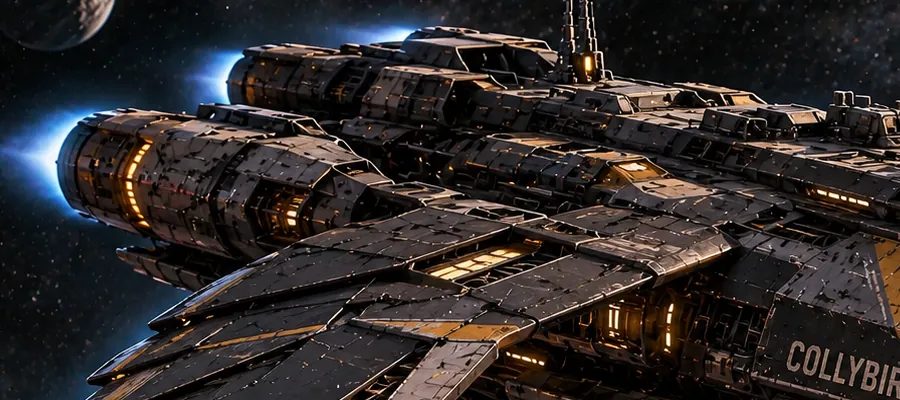
Performance figures, tonnage and crew capacity for the Collybird have not been established. Where a number would help, we'd rather leave the space than make one up.

From orbit to dirt
Most of the places worth going don't have a pad, a tower, or anyone to talk to on the way in. The Collybird was drawn for exactly that: come down steep, put the feet where the ground looks honest, and open the ramp.
Long-travel hydraulic struts with broad feet and real ground clearance, so she sits level on slope, scree or mud.
The feather assemblies partially retract on approach, clearing the ground and tucking the radiator panels out of the way of the work.
One wide hydraulic ramp handles crew, carts and freight together, lit amber end to end. It is the front door and the loading dock.
A smaller hatch near the cockpit for fast on and off, independent of whatever is happening in the cargo bay.
Loading doors under the central fuselage, with external handling points for anything that won't make the turn up the ramp.
No tower, no beacon, no paving required. If there's a flat half-hectare and nobody shooting, that's a spaceport.

Come aboard
The ramp doesn't open onto a corridor. It opens onto the common deck — the room the whole ship is arranged around, and the one place everybody ends up.
There's a table in there that has been bolted down so long the deck plate has worn around it. Mismatched chairs, because they were acquired one at a time, on different worlds, for different reasons. A galley that smells like somebody cooked in it this morning, because somebody did. Tools where tools shouldn't be. Boots by the hatch. A kettle that is older than the drive.
From the common deck the ship branches the way you'd expect a working home to: galley and mess to port, bunks to starboard, cargo and engineering aft, cockpit forward. Nothing is more than a short walk from anything else. That's not efficiency. That's so you can hear each other.

The Collybird's floor plan has never been formally established. Treat the arrangement above as a working proposal rather than canon — the rooms are real, the walls are a suggestion.
Needed: the bolted-down table, mismatched seating, warm overhead light, the open ramp beyond.
Needed: two worn seats, amber instrument glow, hand-labelled switches, a planet outside the canopy.
Needed: exposed conduit, mismatched drive components, tools in reach, one very tired engineer.
The Collybird philosophy
Out here, a ship is more than metal and engines. She's shelter when the weather turns, a lifeline when things go wrong, and the one place in the universe where your people know you'll come back.
The Collybird isn't perfect. Neither are we. That's the point.
The Collybird is a fictional ship from the SPACEPUNK universe. Concept art and design by CollyBird.